

You saw them on TikTok. Someone swears by them. Someone else says it is all hype. And now you are trying to figure out whether Do NAD Gummies Work is actually a question worth asking, or whether NAD supplements are another wellness trend that will fade in six months.
This article is written for the skeptic. Not the biohacker who already has a protocol. Not the person who bought three bottles before looking at a single study. The person who wants to know what the research actually says, what the mechanism is, and whether the specific format of a gummy can deliver what the science documents.
The short answer is that the science is real, the mechanism is documented, and the format matters less than what is inside it. Over 700,000 Goli Zero Sugar 3 Pack bundles have sold on TikTok Shop in under a year, and 10 billion Goli gummies have been sold worldwide since 2018. Here is what the evidence behind those numbers actually says.
The Short Answer
Do NAD gummies work? Yes, when they use the right precursor at the right dose. NAD cannot be efficiently absorbed when taken directly, but NR (Nicotinamide Riboside) converts into NAD inside the cell. Multiple randomized human trials have documented that oral NR supplementation raises blood NAD+ levels measurably. The gummy format does not reduce efficacy. What determines whether it works is the ingredient inside it.
What NAD Is and Why It Matters
Before evaluating any NAD supplement, it helps to understand what NAD is and why declining levels matter for how you feel.
NAD stands for Nicotinamide Adenine Dinucleotide. It is a coenzyme present in every living cell and essential to two processes that determine how well your body produces and sustains energy. The first is cellular respiration, the process of converting nutrients into ATP, the molecule cells use as energy currency. NAD acts as an electron carrier in the mitochondria, feeding electrons into the electron transport chain that powers ATP production. The second is sirtuin activation, a class of proteins that regulate cellular repair, mitochondrial biogenesis, and the stress response system.
NAD declines naturally with age. Research has documented reductions of 50% or more between young adulthood and middle age across multiple tissue types (NIH NIA NAD and aging research). As NAD declines, mitochondrial efficiency drops, cellular repair slows, and the energy system that keeps cognitive and physical performance consistent starts to run below baseline. The fatigue, slower recovery, and reduced cognitive sharpness that most adults associate with getting older are mechanistically linked to this decline.
This is why NAD supplementation is not a wellness trend. It is a response to a documented biological decline with measurable consequences. The NAD cellular energy guide covers the full mitochondrial mechanism in detail.
The Skeptic’s Proof Method
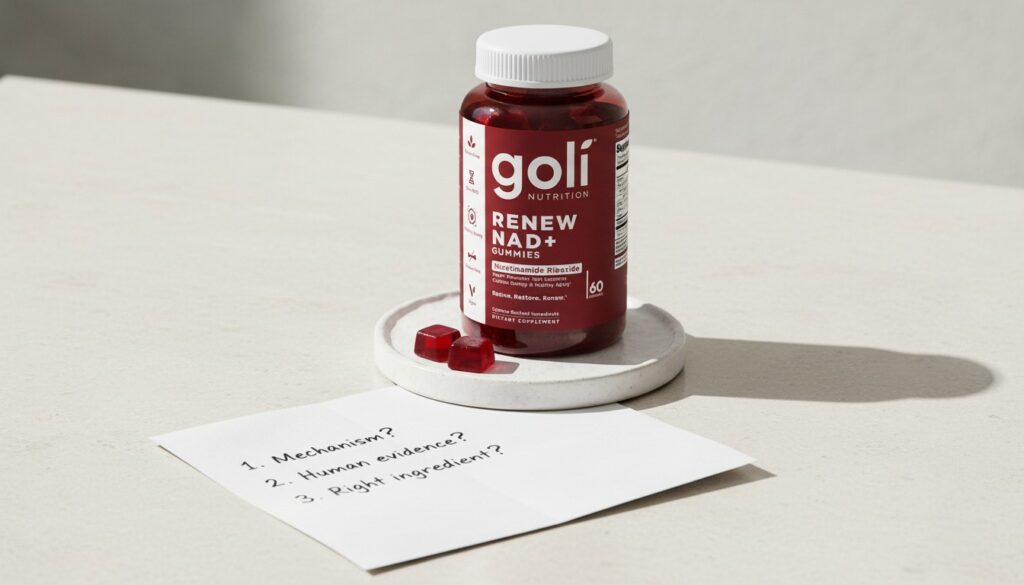
The Skeptic’s Proof Method is a three-step framework for evaluating any NAD supplement claim. It starts with the mechanism, tests it against human evidence, and asks the product-specific question that most reviews skip. Apply it to any NAD product before spending money on it.
Step One: Is the Mechanism Real?
Skeptics are right to question mechanism claims in the supplement industry. Most supplement marketing describes a mechanism with no human evidence behind it. For NAD, the mechanism is not theoretical. It is one of the most studied areas in aging biology, with research conducted at MIT, Harvard, and the NIH over decades.
NAD-dependent energy production through the mitochondrial electron transport chain is basic biochemistry, documented since the early twentieth century. The decline of NAD with age, and its consequences for cellular function, has been replicated across multiple tissue types and multiple research groups. The mechanism passes Step One.
Step Two: Does Human Evidence Support the Outcome?
Mechanism is necessary but not sufficient. The next question is whether oral supplementation with a NAD precursor actually raises NAD levels in humans, not just in cell cultures or animal models.
The answer is yes, with important specificity. NAD itself cannot be efficiently absorbed when taken orally because it is a large molecule that does not cross cell membranes well. The approach that works is taking a NAD precursor, a smaller molecule the body converts into NAD inside the cell. NR (Nicotinamide Riboside) is the precursor with the longest published human trial record.
A randomized, double-blind, placebo-controlled trial documented that NR supplementation raises blood NAD+ levels measurably in healthy middle-aged adults with a strong safety profile (NR and NAD elevation study). A 2026 randomized controlled trial published in Nature Metabolism directly compared NR, NMN, and nicotinamide in 65 healthy adults over 14 days and found both NR and NMN produced comparable NAD+ increases, while nicotinamide did not produce the same sustained effect (NR vs NMN 2026 trial). The human evidence passes Step Two.
Step Three: Does This Specific Product Deliver the Right Ingredient?
This is the step most people skip, and it is the most important one. Knowing that NR works does not tell you whether the specific NAD gummy you are considering contains NR at a dose aligned with the clinical research. Many NAD products on the market use generic nicotinamide, a much cheaper compound that the 2026 Nature Metabolism trial found does not produce the same sustained NAD elevation as NR or NMN.
The product that determines whether a NAD gummy actually works is the one that delivers NR specifically, at a dose matching the published research, in a format that protects the ingredient through manufacturing and storage. NR degrades when exposed to air, moisture, and heat. Products without a protective delivery mechanism may list NR on the label but deliver a compromised ingredient by the time it reaches the cell (Healthline NR supplement overview).
Step Three is the filter that separates effective NAD gummies from ineffective ones.
Why the Gummy Format Does Not Reduce Efficacy
A common skeptic objection: gummies are a format for kids’ vitamins, not serious supplements. The implied concern is that a gummy cannot deliver a meaningful dose of an active compound. This concern is legitimate in general. There are gummies that use the format to deliver trivially small amounts of an ingredient. But it does not apply when the product is engineered correctly.
NR’s efficacy is not format-dependent. It is dose-dependent and formulation-dependent. A gummy that delivers NR at a clinical dose, protected from degradation until consumption, produces the same NAD elevation as a capsule delivering the same ingredient at the same dose. The format is a delivery vehicle. What matters is the passenger.
What does matter about the gummy format for NAD specifically is stability. NR degrades with air, moisture, and heat exposure. A liquid-core gummy that encapsulates NR in a protected format until the moment of consumption directly addresses this vulnerability in a way that standard capsules do not, because standard capsules expose the ingredient to ambient air from the moment the bottle is opened (WebMD nicotinamide riboside overview).
What Actually Happens When You Take a Quality NAD Gummy
The timeline of effects is cumulative, not immediate. Understanding this is essential for evaluating whether any NAD supplement is working.
Blood NAD+ levels begin rising within days of consistent NR supplementation. This molecular change happens faster than the downstream effects become noticeable. Most people begin experiencing felt changes in the first two to four weeks: more consistent energy through the second half of the day, less afternoon cognitive fade, and a sense that recovery from demanding stretches is faster than it used to be.
By weeks four through eight, the cumulative effects on mitochondrial efficiency and sirtuin activity become measurable. This is the window the clinical research uses as its primary measurement point because that is when the systemic changes are most reliably detectable. People who evaluate a NAD supplement after three days and conclude it does not work are stopping before the mechanism has had time to establish itself.
Consistency is the mechanism. Sporadic use does not produce the outcomes that daily consistent supplementation over weeks produced in clinical research.
What Realistic Results Look Like
NAD supplementation does not produce dramatic overnight changes. The results that clinical research documents and that consistent users describe fall into three categories.
Energy distribution is the first. Not more total energy, but better distribution of energy across the day. The afternoon energy cliff that most adults experience becomes less pronounced as mitochondrial efficiency improves. The second half of the workday requires less effort to sustain.
Cognitive clarity is the second. The improvement in focus and mental availability during demanding tasks reflects NAD’s role in neuronal energy metabolism. Neurons are among the most metabolically demanding cells in the body, and improved mitochondrial function affects cognitive performance measurably over weeks of consistent supplementation.
Physical recovery is the third. Muscle tissue recovery after exercise depends heavily on mitochondrial function. People who supplement consistently often find that post-exertion soreness diminishes and subsequent performance feels less compromised by accumulated fatigue.
These are not transformative claims. They are the documented downstream effects of restoring a coenzyme that declines naturally with age to a more functional level.
What the Skeptics Get Wrong About NAD Gummies
Skepticism is healthy but it can also be misdirected. Here are three specific misconceptions that lead people to the wrong conclusion about NAD supplementation.
“The gummy format is just a marketing trick.” The format is irrelevant to efficacy when the ingredient inside is correct and the delivery mechanism protects it. The relevant questions are what the active ingredient is, what dose it delivers, and whether the manufacturing preserves potency. A gummy that answers all three correctly works. One that does not, does not.
“If it worked, doctors would prescribe it.” NAD precursor research is at the clinical science stage, not the pharmaceutical stage. NR does not treat a diagnosable disease. It supports a biological process that declines with age. That puts it outside the prescription model, not outside the evidence base. The clinical trial data is peer-reviewed, published in top-tier journals, and conducted by researchers at major institutions.
“I tried it for two weeks and felt nothing.” Two weeks is too early to evaluate a supplement that works through cumulative mitochondrial adaptation. The clinical trials that documented NR’s effects on NAD levels used 8 to 12 weeks as their primary measurement window. Evaluating at two weeks is like evaluating cardiovascular fitness improvements after two weeks of exercise. The mechanism requires time.
Who Should Be Skeptical and Who Should Try It
Healthy skepticism is appropriate for supplements. Here is a clear-eyed assessment of who this is actually for.
The evidence is strongest for adults in their late 30s and beyond who are experiencing the gradual energy decline, slower recovery, and cognitive changes that track with documented NAD decline. If you are 25 and feel fine, the case for NAD supplementation is weaker because your NAD levels are likely not yet meaningfully depleted.
The evidence is also relevant for high-performers of any age running consistently high metabolic demands. NAD-dependent energy production is a performance concern as well as an aging concern. Demanding careers, intensive training, and chronic stress all accelerate the NAD consumption that the body needs to replenish.
Who should remain skeptical: anyone expecting immediate dramatic results, anyone unwilling to commit to daily consistent use over six to eight weeks, and anyone purchasing a product that cannot confirm NR as the active ingredient at a clinically relevant dose.
Generally well tolerated by healthy adults. Not recommended during pregnancy or breastfeeding. Check with your healthcare provider if you take prescription medications or have existing health conditions (NIH ODS niacin and NAD precursors).
How Long Before You Know If It Works
The honest answer: give it six to eight weeks of daily consistent use before drawing a conclusion.
Blood NAD+ levels begin rising within days. The felt changes in energy and cognition emerge over weeks two through four. The full systemic effect, the one the clinical research measures at its primary endpoints, appears at six to eight weeks. Evaluating a NAD supplement at two weeks is like evaluating cardiovascular exercise at one week. The mechanism requires accumulated time to produce the outcome.
Track two specific markers: afternoon energy availability and recovery from demanding stretches, mental or physical. Those are the outcomes most directly tied to what NR supplementation produces at the cellular level. If both have meaningfully improved at eight weeks of daily use, the supplement is working. If neither has changed, something else is worth examining, including the product’s ingredient form and dose.
Frequently Asked Questions: Do NAD Gummies Work
Do NAD gummies actually work?
Yes, when they use NR (Nicotinamide Riboside) or NMN (Nicotinamide Mononucleotide) as the active ingredient at a clinically relevant dose. NAD cannot be efficiently absorbed when taken directly. NR and NMN are precursors that convert into NAD inside the cell. Multiple randomized human trials have documented that NR supplementation raises blood NAD+ levels measurably. The gummy format does not affect efficacy when the delivery mechanism is designed to protect the ingredient.
How fast do NAD gummies work?
Blood NAD+ levels begin rising within days of the first dose. Felt changes in energy quality and cognitive clarity typically emerge in weeks two through four of consistent daily use. The most consistent and measurable results appear at six to eight weeks, which is the primary measurement window used in published NR clinical trials. The mechanism is cumulative, not acute.
Are NAD gummies safe?
NR is well tolerated in healthy adults across multiple published clinical trials, with mild side effects when they occur, such as occasional nausea or flushing at higher doses. Not recommended during pregnancy or breastfeeding. If you have existing health conditions or take prescription medications, check with your healthcare provider before starting.
How many NAD gummies should I take?
Follow the serving suggestion on the Goli Renew label. The dose was determined based on the range studied in published NR clinical trials and reviewed by Goli’s Scientific and Medical Advisory Board, which includes physicians from Harvard, Stanford, and Duke. Taking more than the recommended serving does not produce proportionally greater results and is not advised without healthcare provider guidance.
Are NAD gummies the same as NMN?
No. NR and NMN are different NAD precursors. Both convert into NAD inside the body, and the 2026 Nature Metabolism head-to-head trial found they produce comparable NAD+ increases in healthy adults after 14 days. NR has a longer published human trial record. NMN is a newer alternative with a growing but shorter evidence base. Neither is “NAD” itself. Both are precursors that the body converts into NAD through different enzymatic pathways. The NAD vs NMN comparison guide covers the 2026 head-to-head trial in full.
Why I Take These Every Day
I spent months watching the NAD skepticism on TikTok Live play out in real time. Thousands of people asking whether their NAD gummies actually work, whether the science is real, whether the gummy format can actually deliver. After 168 consecutive days of Live, my answer has not changed: the skepticism is reasonable, the mechanism is real, and the format question is the wrong question.
The right question is what is inside the gummy and whether it matches what the research studied. The answer for Goli Renew NAD+ Gummies is yes on both counts: NR as the active ingredient in a liquid-core format that protects it until consumption, at a dose reviewed by physicians from Harvard, Stanford, and Duke. After five months of the full daily stack, the clearest signal from the midday NAD gummies is the afternoon. Less fade. More available. The second half of the day no longer requires more effort than the first.
Over 700,000 TikTok shoppers have made this part of their routine, part of 10 billion Goli gummies sold worldwide since 2018. The people who see lasting results take it consistently, every day.
I have secured exclusive TikTok pricing for Better Gut Daily readers. Get access here.
You May Also Like
If the mechanism covered in this article has you wanting to go deeper, the NAD cellular energy guide covers exactly how NAD, sirtuins, and the AMPK signaling axis work together at the mitochondrial level. If you want to understand how NR compares to NMN in clinical detail, the NAD vs NMN comparison article covers the 2026 head-to-head trial in full.
The Better Gut Daily guide covers the complete Goli daily stack with exclusive TikTok Shop pricing for all products at the link below.
Goli Complete Daily Stack Guide
The Bottom Line
Do NAD gummies work? The answer is yes when the right conditions are met: the product uses NR or NMN as the active ingredient, the dose aligns with published clinical research, and the format protects the ingredient until consumption. The Skeptic’s Proof Method confirms it on all three counts: the mechanism is real and documented, human trials show measurable NAD elevation from oral NR supplementation, and the specific product format matters for ingredient stability.
Take it daily. Give it eight weeks. Track afternoon energy and recovery from demanding stretches. Those are the markers that reflect what NR supplementation actually produces at the cellular level.
Over 700,000 TikTok shoppers have made Goli part of their daily routine, and 10 billion Goli gummies have been sold worldwide since 2018. Consistency is the only variable that separates results from none.
References
1. Martens CR et al.: Chronic NR supplementation raises NAD+ in healthy middle-aged adults. PMC, 2018:
2. Christen S et al.: NR vs NMN vs nicotinamide in humans. Nature Metabolism, 2026:
3. National Institute on Aging: NAD metabolism and aging research:
4. Healthline: Nicotinamide riboside benefits and research:
5. WebMD: Nicotinamide riboside uses, safety, and overview:
6. NIH Office of Dietary Supplements: Niacin and NAD precursor health professional fact sheet: