

Perimenopause bloating can feel especially confusing because it often shows up when your usual habits have not changed much. A meal you handled fine last year suddenly leaves your waistband tight, your stomach feels fuller by evening, or constipation starts appearing more often. The timing makes hormones an obvious suspect, but hormones are only part of the story.
Since late May 2025, the Zero Sugar 3 Pack tally on TikTok Shop has moved past 750,000 bundle sales. That does not prove a supplement fixes hormone-related bloating. What it does show is that a simple, repeatable routine matters to a lot of people, which is useful here because perimenopause is already variable enough without changing five things at once.
The Short Answer
Perimenopause bloating can happen as estrogen and progesterone fluctuate, but hormones are rarely the only variable. Slower gut movement, constipation, food tolerance, stress, sleep disruption, meal size, and fluid retention can all add to the pressure. The practical move is to track the pattern, support regular digestion, and use targeted gut or stress support without pretending one product can correct the menopause transition itself.
Why Perimenopause Can Change Digestion
Perimenopause is the transition before menopause, and the hormone pattern is not a smooth decline. Estrogen and progesterone can rise, fall, and behave less predictably while periods become more irregular. Mayo Clinic describes this stage as a time of changing cycles alongside symptoms that can include hot flashes, sleep disruption, mood changes, and bladder or vaginal changes. Mayo Clinic’s perimenopause overview is useful because it frames perimenopause as a transition, not one fixed hormone state.
The gut is part of that picture.
Cleveland Clinic notes that digestive complaints around menopause can include bloating, gas, constipation, abdominal discomfort, and changing bowel patterns. Hormonal shifts may affect gut motility, while stress, activity, fiber intake, and hydration can push the same symptoms in either direction. Cleveland Clinic’s discussion of digestive issues during menopause makes an important distinction: a hormone-related change can influence digestion without making every episode of bloating a hormone problem.
That is the part worth keeping.
A slower bowel can create more pressure.
A larger late meal can create more pressure.
Poor sleep and a stressful day can change appetite, meal timing, and how sensitive your gut feels.
And if several of those land on the same week as a hormone swing, the result can feel much bigger than any one factor alone.
There is also growing interest in the gut microbiome during the menopause transition. A 2025 review in Post Reproductive Health described evidence that changing sex hormones may be associated with shifts in gut microbial composition and function, while also stressing that the evidence is still developing and many findings are associative rather than proof of cause and effect. The menopause and gut microbiota review is a good reason to take gut support seriously without turning the microbiome into an explanation for everything.
The useful target is not a perfect microbiome.
It is a more predictable digestive pattern.
The Three-Signal Bloat Check
I use a simple way to think about this: The Three-Signal Bloat Check.
Signal one is timing. Does the bloating change across your cycle, show up around skipped or delayed periods, or travel with other perimenopause symptoms such as sleep changes or hot flashes?
Signal two is gut mechanics. Are bowel movements less frequent, harder, incomplete, or more variable than they used to be? Are you eating larger meals, more quickly, later at night, or suddenly pushing much more fiber?
Signal three is stress load. Did the bloating get louder during a stretch of poor sleep, work pressure, caregiving, travel, or irregular meals?
You do not need all three signals.
The point is to stop asking one oversized question, “Is this hormones or my gut?” and start asking what is actually happening on the days the bloating is worst.
That gives you something you can act on.
Step-by-Step: The Three-Signal Bloat Check for Perimenopause Bloating
Step One: Track Timing Before You Remove Foods
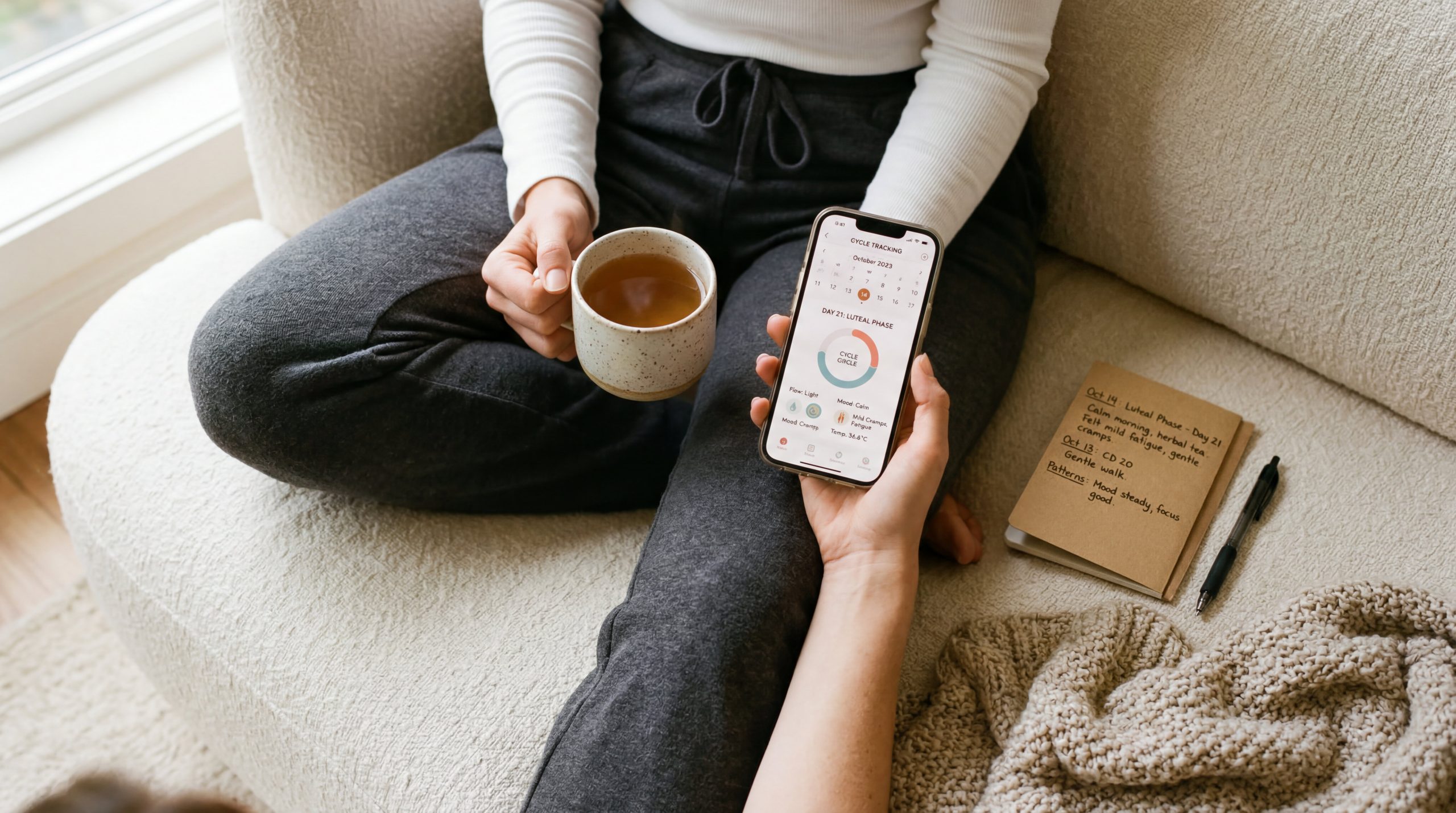
Start with seven to fourteen days of simple notes.
Track when the bloating starts, whether it is present on waking or builds through the day, how your bowel movements are going, where you are in your cycle if you can tell, and whether sleep or stress has been unusually rough.
Keep it basic.
You are looking for repetition, not creating a medical spreadsheet.
If the pattern shows up around irregular cycles and other perimenopause symptoms, hormones may be part of the background. If it reliably appears after the same meal, during constipation, or after several late dinners, you have another clue.
The point is not to diagnose yourself.
It is to stop guessing.
Step Two: Check Constipation Even If You Still Go Every Day
Constipation does not always mean no bowel movement for four days.
You can go daily and still have hard stools, straining, incomplete emptying, or a sense that things are moving more slowly. That matters because stool and gas sitting longer in the digestive tract can make abdominal pressure feel much worse.
NIDDK recommends adequate fiber and fluids for constipation and specifically advises increasing fiber gradually rather than making a huge jump all at once. The NIDDK constipation guidance gives an adult fiber range of roughly 22 to 34 grams per day depending on age and sex.
Do not treat that number like a race.
If your current intake is low, adding bran cereal, beans, chia, lentils, and a giant salad on the same day can give your gut a lot more fermentation than it is used to.
Add fiber in steps.
Pair it with enough fluid.
And watch whether bowel movements become easier instead of simply making the bloating louder.
Step Three: Change Meal Size Before You Blame Every Ingredient
Perimenopause often lands in a busy stage of life.
Breakfast disappears.
Lunch gets pushed back.
Then dinner becomes the first real meal of the day.
That pattern can make bloating feel like a food intolerance when the more obvious issue is that the gut just received a very large volume of food at once.
Try a steadier meal pattern for several days before cutting out gluten, dairy, beans, fruit, or every fermentable carbohydrate you can find online.
Smaller changes are easier to read.
And they are much easier to live with.
Step Four: Use Gut Support as Support, Not Hormone Treatment
A probiotic does not regulate perimenopause.
It does not replace medical care, and it should not be sold as a fix for fluctuating estrogen or progesterone.
What a probiotic can do is provide a specific microorganism with a specific evidence base.
For example, Bacillus subtilis DE111 has human evidence showing that its spores can survive gastrointestinal transit and germinate in the small intestine. In that ileostomy study, the strain was detectable within hours after ingestion. The DE111 trial involved Deerland Probiotics employees and the strain owner, so that commercial relationship belongs beside the finding.
That study does not show DE111 treats perimenopause.
It answers a narrower formulation question: can this specific probiotic survive the trip?
That is the kind of precision I want in a gut routine.
Step Five: Treat Stress as a Parallel Signal
Stress does not mean the bloating is imaginary.
The gut and nervous system are connected, and stressful stretches can change meal timing, bowel habits, sleep, appetite, and how strongly digestive sensations register.
That is why I separate gut support from stress support instead of pretending one product does both jobs.
Ashwagandha has human research in perimenopausal women, but the claim needs to stay where the evidence is. In an eight-week randomized, double-blind, placebo-controlled trial of 100 women with climacteric symptoms, ashwagandha root extract was associated with improvements in menopause symptom and quality-of-life scores compared with placebo. The perimenopause ashwagandha trial used 300 mg of extract twice daily, so its results should not be automatically transferred to every ashwagandha product or dose.
The study was not a bloating trial.
That matters.
I use ashwagandha for the stress and sleep side of my routine, not as a claim that it treats abdominal bloating.
The Myth: Every New Bloat Is Just Hormones
This is the myth I would drop first.
When bloating starts in your forties, it is easy to say, “Well, perimenopause,” and move on. Sometimes that explanation is partly right. Hormone fluctuations can influence motility, fluid balance, bowel patterns, and gut sensitivity.
But “partly right” is not the same as complete.
Constipation still counts.
A new medication still counts.
Large meals still count.
A food intolerance still counts.
IBS still counts.
And persistent bloating that is new or clearly different from your normal pattern deserves more attention than a hormone shrug.
The American Cancer Society lists bloating, pelvic or abdominal pain, trouble eating or feeling full quickly, and urinary urgency or frequency among symptoms that warrant medical attention when they are persistent or represent a change from normal. The American Cancer Society symptom guidance does not mean persistent bloating equals cancer. It means a symptom that keeps showing up should not automatically be filed under menopause without being evaluated.
That distinction protects you from both extremes.
You do not need to panic over every bloated evening.
But you also do not need to normalize a persistent new symptom just because you are in perimenopause.
What Improvement Should Actually Look Like
The goal is not a completely flat stomach at 8 p.m.
Normal digestion creates gas.
Food takes up space.
Your abdomen can look and feel different after meals than it does first thing in the morning.
A useful improvement looks more ordinary.
The uncomfortable days become less frequent.
Constipation eases.
You can connect the worse days to a pattern instead of feeling blindsided.
Your meals become more predictable.
You stop removing foods at random.
And your routine is simple enough that you know what you are actually doing.
That last part matters more than it sounds.
If you start a probiotic, double your fiber, quit dairy, add magnesium, start ashwagandha, stop coffee, and change breakfast in the same week, you may feel different but you will not know what changed the pattern.
Consistency gives you information.
That is the win.
Who This Approach Is For
This approach fits someone who has started noticing bloating during the menopause transition but does not yet have a clear pattern.
Maybe your periods have become irregular.
Maybe sleep is worse.
Maybe constipation appeared at the same time.
Maybe your gut feels more reactive after meals that never used to bother you.
The Three-Signal Bloat Check is useful because it keeps hormones in the picture without letting hormones swallow the whole explanation.
It also fits someone who has already bought several gut products and wants to stop treating each uncomfortable evening like an emergency.
But there is a line.
New, persistent, or worsening bloating should be discussed with a clinician, especially when it comes with pelvic or abdominal pain, feeling full unusually quickly, urinary changes, vomiting, bleeding, unexplained weight loss, fever, or a major lasting change in bowel habits.
That is not a supplement question.
It is an evaluation question.
How Long the Bloating Can Take to Settle
There is no honest seven-day countdown.
Perimenopause itself can last for years, and the hormone pattern can change across that time. That does not mean the bloating has to stay constant for years.
If constipation is a major driver, improving stool consistency and bowel regularity may change the pressure within days or weeks.
If meal size and timing are part of the problem, the pattern may become clearer within a week or two.
If stress and poor sleep are amplifying everything, improvement may track with a steadier routine rather than one specific food.
And if the bloating keeps occurring regardless of what you change, that is useful information too.
Do not keep escalating supplements just because the calendar says you should feel better by now.
A routine should give you a clearer signal.
If it does not, reassess.
Perimenopause Bloating: Common Questions
Why am I so bloated during perimenopause?
Hormone fluctuations can influence digestion, fluid balance, bowel patterns, and gut sensitivity, so perimenopause may make bloating more noticeable. But constipation, meal size, food tolerance, stress, sleep, activity, and medications can contribute at the same time. Look for the pattern rather than assuming hormones are the only cause.
How do you get rid of perimenopause bloating?
Start with the drivers you can actually observe: bowel regularity, gradual fiber intake, hydration, meal size, meal timing, movement, and repeat food triggers. I use Goli Pre+Post+Probiotics Gummies as part of my morning gut-support routine, while Goli Ashwagandha Gummies fit the separate stress and sleep side. Neither product treats hormone fluctuations. Persistent or worsening bloating deserves medical evaluation rather than endless self-experimenting.
Does perimenopause cause constant bloating?
It can contribute to frequent bloating, but constant bloating should not automatically be attributed to perimenopause. If abdominal swelling is persistent, new, worsening, or paired with pain, early fullness, urinary changes, vomiting, bleeding, weight loss, or a lasting bowel change, talk with a clinician.
What foods help with perimenopause bloating?
There is no single anti-bloat food. A steadier pattern usually matters more: enough fluid, gradually increased fiber, fruits and vegetables you tolerate, whole grains, legumes in manageable portions, and regular meals. If raw vegetables or large bean servings make symptoms worse, reduce the portion and build back gradually rather than banning whole food groups immediately. If you want the probiotic, prebiotic, and postbiotic pieces separated clearly, what are postbiotics explains that layer in plain language.
Why is my bloating worse at night?
Evening bloating can reflect a full day of food, gas production, stool buildup, larger dinners, rushed eating, or constipation. The timing does not automatically mean something is wrong. If you wake relatively comfortable and symptoms build after meals, meal size, bowel regularity, and specific food patterns are useful places to look.
Where Goli Fits Into My Routine
A viewer once asked me during a TikTok Live why her stomach could feel normal one week and completely different the next even though she was eating “the same stuff.”
That is perimenopause in a sentence.
The variables move.
So I would not build a routine around the promise that one gummy fixes hormones or erases bloating.
For the gut side, I use Goli Pre+Post+Probiotics Gummies in the morning. The probiotic routine helps keep my gut running smoothly and my digestion more consistent. The formula combines Bacillus subtilis DE111, XOS, and heat-treated Lacticaseibacillus paracasei MCC1849, giving it a live probiotic, prebiotic, and postbiotic layer.
For the stress side, I use Goli Ashwagandha Gummies in the evening. Ashwagandha has been the product I associate most with better sleep and lower stress in my own routine.
Those are separate jobs.
I do not call the probiotic a hormone treatment.
I do not call ashwagandha a bloating treatment.
I use them because digestion, stress, and sleep can all matter during a stage when the background hormone pattern is already less predictable.
By this point, more than 750,000 Zero Sugar 3 Pack bundles have been sold through TikTok Shop since late May 2025. That number is sales volume, not proof of efficacy or a count of unique buyers. The reason I care about the format is simpler: morning gut support and evening stress support are easy to repeat long enough to judge.
You May Also Like
If your bigger question is how to get digestion back to a more predictable baseline, read how to reset your gut next. It walks through the difference between a real routine reset and the cleanse-style version that creates more noise than information.
The Bottom Line
Goli fits this kind of midlife bloating as support around the problem, not as a treatment for the menopause transition itself. I use Pre+Post+Probiotics for consistent digestion and Ashwagandha Gummies for the stress and sleep side of my routine, while keeping the hormone claim exactly where it belongs.
Today, check the pattern before you overhaul the menu. Look at bowel regularity, meal size, timing, hydration, cycle changes, stress, and sleep. Keep gut support and stress support simple enough to repeat, and do not let a new persistent symptom get dismissed as “just hormones.”
That same Zero Sugar 3 Pack has crossed 750,000 bundle sales on TikTok Shop since late May 2025. The sales number cannot tell you why your abdomen feels different this month. A routine that separates hormone timing, gut mechanics, and stress load can.
References
- Mayo Clinic. “Perimenopause: Symptoms and causes.” Updated 2026.
- Cleveland Clinic. “Navigating Digestive Issues During Menopause.” Butts & Guts.
- Liaquat M, Minihane AM, Vauzour D, Pontifex MG. “The gut microbiota in menopause: Is there a role for prebiotic and probiotic solutions?” Post Reproductive Health. 2025;31(2):105-114.
- National Institute of Diabetes and Digestive and Kidney Diseases. “Eating, Diet, & Nutrition for Constipation.”
- Colom J, Freitas D, Simon A, et al. “Presence and Germination of the Probiotic Bacillus subtilis DE111 in the Human Small Intestinal Tract: A Randomized, Crossover, Double-Blind, and Placebo-Controlled Study.” Frontiers in Microbiology. 2021;12:715863. Study involved Deerland Probiotics employees and the strain owner.
- Gopal S, Ajgaonkar A, Kanchi P, et al. “Effect of an ashwagandha (Withania somnifera) root extract on climacteric symptoms in women during perimenopause: A randomized, double-blind, placebo-controlled study.” Journal of Obstetrics and Gynaecology Research. 2021;47(12):4414-4425.
- American Cancer Society. “Signs and Symptoms of Ovarian Cancer.” Updated 2025.