

The benefits sold on a beetroot supplement label and the benefits demonstrated in people are not the same list.
That is not a complaint about marketing. It is a description of where the research sits. Beetroot contains two families of interesting compounds, and they have been studied in completely different ways. The nitrate has human trials behind it. The betalains, the pigments that make it red and that most of the antioxidant claims rest on, have mostly been studied in test tubes and rodents.
So the useful question about beetroot supplement benefits is not whether beetroot does anything. It is which of the things it does have been shown to happen in a person, at a dose you can actually swallow.
Goli’s output since 2018 is counted in billions of gummies, and beetroot questions have climbed steadily as the ingredient has spread across the supplement aisle.
The Short Answer
Beetroot supplement benefits divide by evidence quality. Human trials support exercise performance and recovery, using concentrated juice supplying several hundred milligrams of nitrate. Basic nutrition, including folate and fibre, is established but modest. Antioxidant and anti-inflammatory claims rest largely on cell and animal studies of betalain pigments. One trial of 600 mg beetroot extract found negligible effects.
The Evidence Spectrum, From Human Trials to Test Tubes
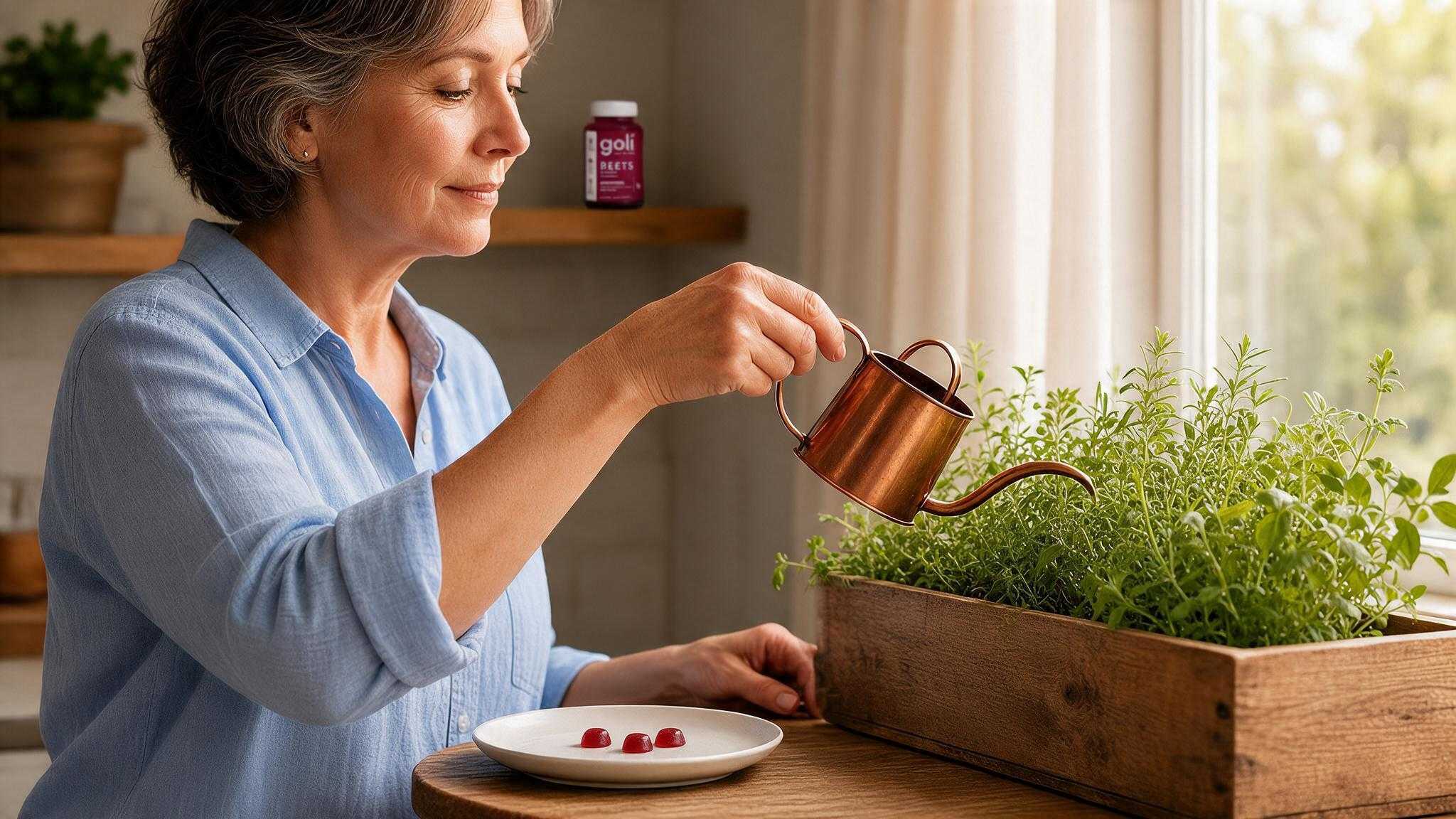
Sorting the claims by what kind of study supports each one makes the whole category legible.
Strongest: exercise performance and recovery, from juice. A randomised double-blind crossover trial in resistance-trained men found beetroot juice increased repetitions at 80 percent of one-rep max, improved movement velocity, raised muscle oxygenation and accelerated neuromuscular recovery. Similar work has found faster recovery of jump performance after repeated sprints. These are real, replicated, human findings.
That format gap has been measured elsewhere too. A meta-analysis of eleven trials in hypertensive patients used doses of 200 to 800 mg of nitrate daily, which is the concentration a juice delivers and a capsule does not.
Established but modest: basic nutrition. Beetroot supplies folate, fibre, potassium and manganese in meaningful amounts per serving of the vegetable. That is worth something, and it is a property of eating beetroot rather than of supplementing it, since a capsule or gummy contains a fraction of a serving.
Preclinical: antioxidant and anti-inflammatory activity. This is where most of the marketing lives and where the evidence is thinnest in humans. A review of beetroot as a functional food describes the betalain pigments as displaying antioxidant and anti-inflammatory activity, with the supporting work drawn from in vitro, animal and a limited number of human studies. Those are the words the researchers use, and the distinction between a cell culture and a person is the whole point.
Weakest: the extract itself, at supplement doses. A randomised crossover trial gave 600 mg of beetroot extract to sixteen healthy men before submaximal aerobic exercise and found negligible effects on cardiovascular and autonomic recovery. Its authors noted the formulation is widely sold for exactly that purpose.
Betalains, and Why They Are Interesting Anyway
Worth explaining, because the preclinical evidence is genuinely intriguing rather than worthless.
Betalains are the water-soluble pigments that give beetroot its colour, split into red-violet betacyanins and yellow-orange betaxanthins. Beetroot is one of the few vegetables that contains them at all. The main one, betanin, scavenges reactive nitrogen species and inhibits inflammatory signalling in laboratory conditions.
The reason that matters less than it sounds is bioavailability and time. Betalains circulate briefly and are excreted in urine within hours of eating, which is why beetroot can turn urine pink. A compound that is impressive in a dish and gone by evening has a harder path to a chronic health effect than the laboratory work suggests.
None of that makes betalains useless. A meta-analysis of twenty-two trials argued that beetroot’s blood pressure effect is partly independent of its nitrate, attributing some of it to betalains, flavonoids and vitamin C. So the pigments may be doing something in people after all, just not the thing the antioxidant marketing describes.
What that leaves is a promising research subject rather than a settled benefit, and those two things get sold at the same price.
Where the Dose Problem Bites
The gap between the trial format and the shelf format is wider here than in most categories.
The performance trials used concentrated juice, typically providing 6 to 13 millimoles of nitrate, which works out to several hundred milligrams. A beetroot powder capsule commonly contains 500 milligrams of powder in total, of which the nitrate is a small fraction and often unstated.
That single fact explains why one trial found strength and recovery benefits and another found negligible effects. They were not testing the same thing. One tested juice at a nitrate dose, the other tested extract at a capsule dose.
So the honest reading is that beetroot works in the format the research used, and the format most people buy is not that one.
The reason the juice keeps winning is unglamorous. Nitrate is not potent, it is abundant: the effect depends on getting a few hundred milligrams into you, and the only practical way to do that is to concentrate a lot of vegetable into a small volume of liquid. Encapsulating it means losing the water and, with it, most of the room the dose needs.
That is a formulation limit rather than a failure of intent. No amount of better manufacturing gets a nitrate dose into a gummy, which is why every product that claims the performance research in that format is claiming something the format cannot deliver.
Assumptions That Cost People Money Here
Four beliefs shape what people buy in this aisle, and none of them survives contact with the labels.
That beetroot is the active ingredient in a beetroot product. Frequently it is not. Many formulas pair beetroot with something else doing the measurable work, and the beetroot supplies the name, the colour and the picture on the front. Reading the ingredient panel in order of quantity settles this in seconds.
That processing preserves what matters. It preserves one thing and destroys another. Heat degrades betalains substantially while nitrate survives it, so a processed product tends to keep the compound with human evidence and lose the one the antioxidant marketing describes. That is arguably the right trade, and nobody makes it deliberately or explains it.
That a bigger milligram number means a stronger product. In this category the headline number is usually total powder weight, which tells you how much beetroot went in and nothing about what came out. Two products at 1,000 mg can differ tenfold in nitrate.
That organic or cold-pressed matters more than dose. Growing conditions do affect nitrate content, which is exactly why a product’s own measurement matters more than its production story. A cold-pressed organic powder that does not state its nitrate content is as unmeasurable as any other.
Why the Two Evidence Bases Diverged
There is a reason the nitrate has human trials and the betalains mostly do not, and it is not that anyone decided the pigments were unimportant.
Nitrate produces an effect you can measure within hours, in healthy volunteers, with equipment most exercise labs already own. Blood pressure cuffs and near-infrared spectroscopy give you a number the same afternoon. That makes for cheap, fast, repeatable trials, which is why there are so many of them.
Betalains promise the opposite kind of benefit. Antioxidant and anti-inflammatory effects are slow, diffuse, and hard to attribute to one compound in a person eating a varied diet. Demonstrating them properly means long trials with soft endpoints, and those are expensive and often inconclusive.
So the imbalance in the literature reflects what is easy to study rather than what matters most. That cuts both ways: it does not mean the pigments do nothing, and it does not entitle anyone to sell them as though the case were closed.
Realistic Expectations by Format
Setting this by format rather than by ingredient prevents most of the disappointment.
If you drink concentrated beetroot juice at a stated nitrate dose, the performance effects appear within two to three hours and the recovery effects over days of consistent use. If you take a beetroot capsule or gummy, expect a small nutritional contribution and nothing measurable in performance, because that is what the extract trial found.
Neither format produces a sensation. The outcomes in these trials are muscle oxygenation, jump height and heart rate variability, measured with equipment.
Reading a Beetroot Label in Three Moves
Three checks, and the first eliminates most of the shelf.
Step One: Look for Nitrate in Milligrams
Not total powder weight, not a proprietary blend, not a percentage. The human performance research measured nitrate, so a product that does not state its nitrate content cannot be compared to any of it. Most do not state it.
Step Two: Work Out Which Compound You Are Buying For
Nitrate for performance and blood flow, betalains for the antioxidant claims. They are different molecules with different evidence bases, and processing treats them differently: heat degrades betalains substantially while nitrate is more stable.
Step Three: Check What Else Is Carrying the Product
Many beetroot supplements pair the beetroot with something else that is doing the actual work on the label. That is not dishonest, but it means the beetroot may be the name rather than the active ingredient, and the two are easy to confuse when the picture on the front is a beetroot.
Who This Suits and Who Should Be Careful
Some people should approach this differently.
Anyone with a history of calcium oxalate kidney stones should be cautious, since beetroot is high in oxalate. That caution is being studied rather than assumed: a registered trial is testing beetroot extract in chronic kidney disease patients precisely because the risk and the potential benefit sit in the same population. Anyone on blood pressure medication should speak to a doctor, since the nitrate pathway works on the same system, and our piece on does beetroot lower blood pressure sets out what the trials found and at what dose. And anyone who finds red urine alarming should know about beeturia in advance rather than discovering it.
Beetroot supplements are a reasonable small addition for somebody already eating well and curious about the ingredient. They are not a substitute for the juice if performance is the goal, and because supplements are not assessed for effectiveness before sale, the format check above is the only screening this category receives.
Beetroot Supplement Benefits: Your Questions Answered
What are the proven beetroot supplement benefits?
The best-supported benefits are exercise performance and recovery, demonstrated in randomised trials using concentrated juice at nitrate doses of several hundred milligrams. Antioxidant and anti-inflammatory benefits appear in cell and animal studies of betalain pigments but have not been demonstrated in humans taking supplements. One trial of 600 mg beetroot extract found negligible effects on recovery.
How long does it take for a beetroot supplement to work?
For the nitrate pathway, effects on blood flow and exercise appear within two to three hours of a dose and fade within a day, which is why trials dose daily rather than weekly. Recovery benefits in the resistance training work built over three days of consistent supplementation. Nothing here accumulates into a lasting change once you stop.
Is beetroot powder as good as beetroot juice?
The evidence says no, and the reason is dose rather than form. Trials used juice supplying 6 to 13 millimoles of nitrate, while a typical powder capsule holds 500 mg of powder in total with the nitrate content a small and often unstated fraction. A product that does not report its nitrate content cannot be compared to any of the research.
Do beetroot supplements help with inflammation?
In laboratory conditions, betalain pigments inhibit inflammatory signalling and scavenge reactive species convincingly. In people taking supplements, that has not been demonstrated. The pigments are also excreted within hours, which complicates the path from a brief circulating presence to a sustained anti-inflammatory effect.
Why does beetroot turn urine red?
That is beeturia, caused by betalain pigments passing into urine, and it is harmless. It varies between people and between occasions, and it stops when you stop eating beetroot. If red urine appears when you have not eaten beetroot, that is a different matter and worth a doctor’s attention.
Which beetroot supplement should I buy?
Look for a stated nitrate content rather than a total powder weight, since the nitrate is what the human trials measured. Most products do not report it. Goli’s Beets Cardio gummies are built around CoQ10 rather than nitrate, so they answer a different question than the performance research does.
Weighing the Label Against the Trials
If the human evidence belongs to juice at nitrate doses, then the honest thing to say about any beetroot gummy is what it is actually for.
Goli Beets Cardio Gummies lead with CoQ10 at 100 milligrams, with beet root powder extract and Vitamin B12 alongside. The beetroot is not there at a nitrate dose and I would rather say that than let the name imply the performance research applies. A viewer asked during a Live whether these would do what the beetroot juice her son drinks does, and the answer was no, and that the juice was the right product for what she was describing. What these are is a CoQ10 product with beetroot in it, which is a smaller claim and a true one. Billions of gummies on, nothing has been sold here as a pre-workout. See what leads the label.
You May Also Like
Chemical form decides more than dose in some comparisons. Citicoline vs alpha GPC works through a case where two supplements with the same goal diverge because of what gut bacteria do with each one.
The Bottom Line
So beetroot supplement benefits sort into what has been shown in people and what has been shown in a dish. Performance and recovery from juice sit in the first pile. Antioxidant and anti-inflammatory claims sit in the second.
Today, if performance is what you want, look for a product stating its nitrate content in milligrams and treat anything reporting only total powder weight as unmeasurable.
Then read the rest of the label for what else is in it, because most beetroot products are carrying something other than beetroot as the active ingredient. Goli sells a lot of gummies and has never once pointed at the juice research to do it, which on this shelf is the signal worth reading.
References
- Salem A, Ammar A, Kerkeni M, et al. Short-Term Beetroot Juice Supplementation Enhances Strength, Reduces Fatigue, and Promotes Recovery in Physically Active Individuals: A Randomized, Double-Blind, Crossover Trial. Nutrients, MDPI (2025);17(10):1720.
- Grönroos R, Eggertsen R, Bernhardsson S, Praetorius Björk M. Effects of Beetroot Juice on Blood Pressure in Hypertension According to European Society of Hypertension Guidelines: A Systematic Review and Meta-Analysis. Nutrition, Metabolism and Cardiovascular Diseases (2024).
- Kaya EÖ, Kabasakal Çetin A. Health Effects of Red Beetroot as a Functional Food: Healing From the Root. Journal of Food Science, Institute of Food Technologists (2025);90(4):e71053, doi 10.1111/1750-3841.71053.
- Bahadoran Z, Mirmiran P, Kabir A, Azizi F, Ghasemi A. The Nitrate-Independent Blood Pressure-Lowering Effect of Beetroot Juice: A Systematic Review and Meta-Analysis. Advances in Nutrition (2017);8(6):830-838. Erratum in Advances in Nutrition (2018);9(3):274.
- Benjamim CJR, de Sousa Júnior FW, Porto AA, et al. Negligible Effects of Nutraceuticals from Beetroot Extract on Cardiovascular and Autonomic Recovery Response following Submaximal Aerobic Exercise in Physically Active Healthy Males: A Randomized Trial. International Journal of Environmental Research and Public Health (2023);20(5):4019.
- Beetroot Extract Supplementation Associated With an Exercise Protocol for Chronic Kidney Disease Patients. ClinicalTrials.gov, NCT06286748.
- FDA 101: Dietary Supplements. U.S. Food and Drug Administration.